Goldenrod, Sappho, and Being a Good Ancestor to This Land
Finding my spot
Market days wear us out. This one wore out both of us. Johnny went to lie down for a few minutes, the house got quiet, and I snuck out to the woods behind our place with a book.
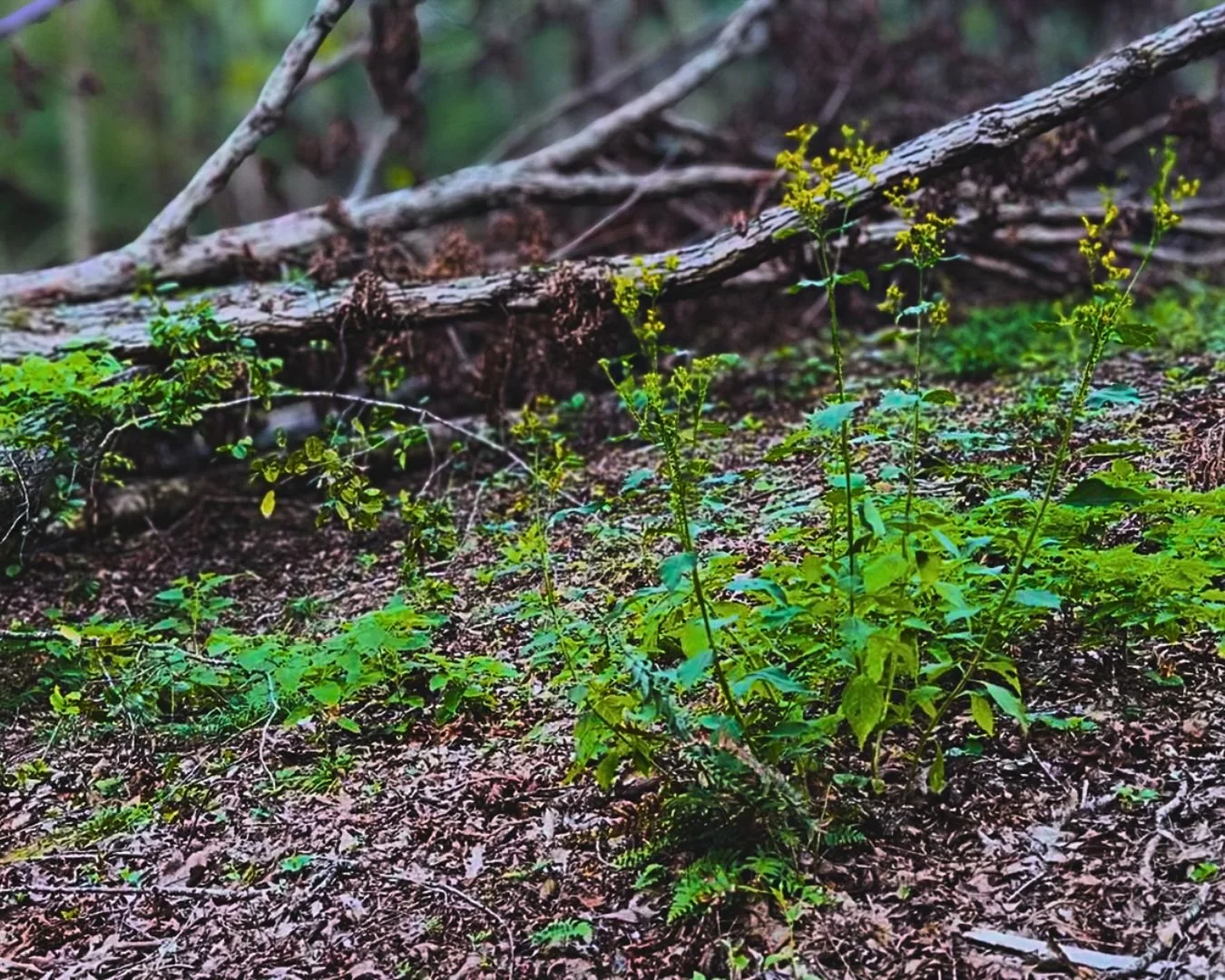
I've been looking for a spot back there for a while. Somewhere cozy and safe and quiet that could just be mine. This time I found it: a little cleared-out patch in front of some old logs, with goldenrod blooming right in the middle of it.
Goldenrod is bright yellow, like the sun, and finding it blooming back there under the trees felt like a good sign. A reminder that good things can still come up in darker places. It's zigzag goldenrod, one of the few kinds that blooms in the shade.
So I sat down in front of those logs, set my phone up so we could listen to the birds together, and read.
Reading Sappho for the first time
This was my first time reading Sappho. I read the introduction to the translation and then all of the poems themselves, which doesn't take long, because most of what she wrote didn't survive. What's left is fragments. Scraps of lines, after centuries of war and fire and everything else.
It's incredibly emotional to read. You're holding pieces of something that was whole once, and you can feel how much is missing.
I read Diane Rayor's translation, edited with André Lardinois, and what I loved is that it gives you the context for every piece: where the fragment was found, the area it came from, and the time period it's dated to. You're not just reading scraps. You know where they've been.
I'm still new to ancient Greece. I know Homer. I read the Odyssey again earlier this summer, and the first time I ever heard it, it was read to me by my Latin teacher in high school. Beyond that I'm a beginner, and I'm enjoying being one.
If you want to read it too: Sappho: A New Translation of the Complete Works, translated by Diane J. Rayor, edited by André Lardinois. Amazon
As an Amazon Associate I earn from qualifying purchases.
Being a good ancestor to this land
On the walk back to the house I started thinking about the land more than the book.
This farm is the gift of a lifetime. And I feel pulled not just to farm it, but to protect it, to speak up for its future, to be a good ancestor to it.
I think a lot about the people who came before me, especially the women, who worked hard and didn't get the chances I have. My great-grandparents came to this country as children, with parents who were looking for work. My grandparents did have a farm. They married, they farmed it, and then it was taken for eminent domain. They didn't get a choice, and they didn't get a say in the price. If you go looking for it today, it's an overpass in Texas.
That sits with me every time I'm out in the field. In three generations a farm can be forgotten. Not just sold. Gone. Paved over. No soil left.
My name might be on the deed to this place, but we only get 60 or 80 years, maybe a few more if we're lucky. So while I'm here I want to be good to this land, and hope it's good to us. I want to raise good people. Maybe my grandkids and great-grandkids get something out of it someday.
I don't want to be greedy with it, either. I want to serve other people while I protect it, and make sure it's still farmland three generations from now.
I know that all sounds a little woo-woo for an afternoon after market. But that's where my head was. Then I walked back to the house, realized I'd left my bookmarks out there, walked all the way back out to get them, and started packing for vacation. Normal afternoon, mostly.